A search can finish successfully while following the wrong update rule. EvoX 1.4.1, released on October 30, 2026, addresses that gap in SHADE, differential evolution and CMA-ES: the corrections restore adaptation, sampling and execution behavior that the algorithms depend on.
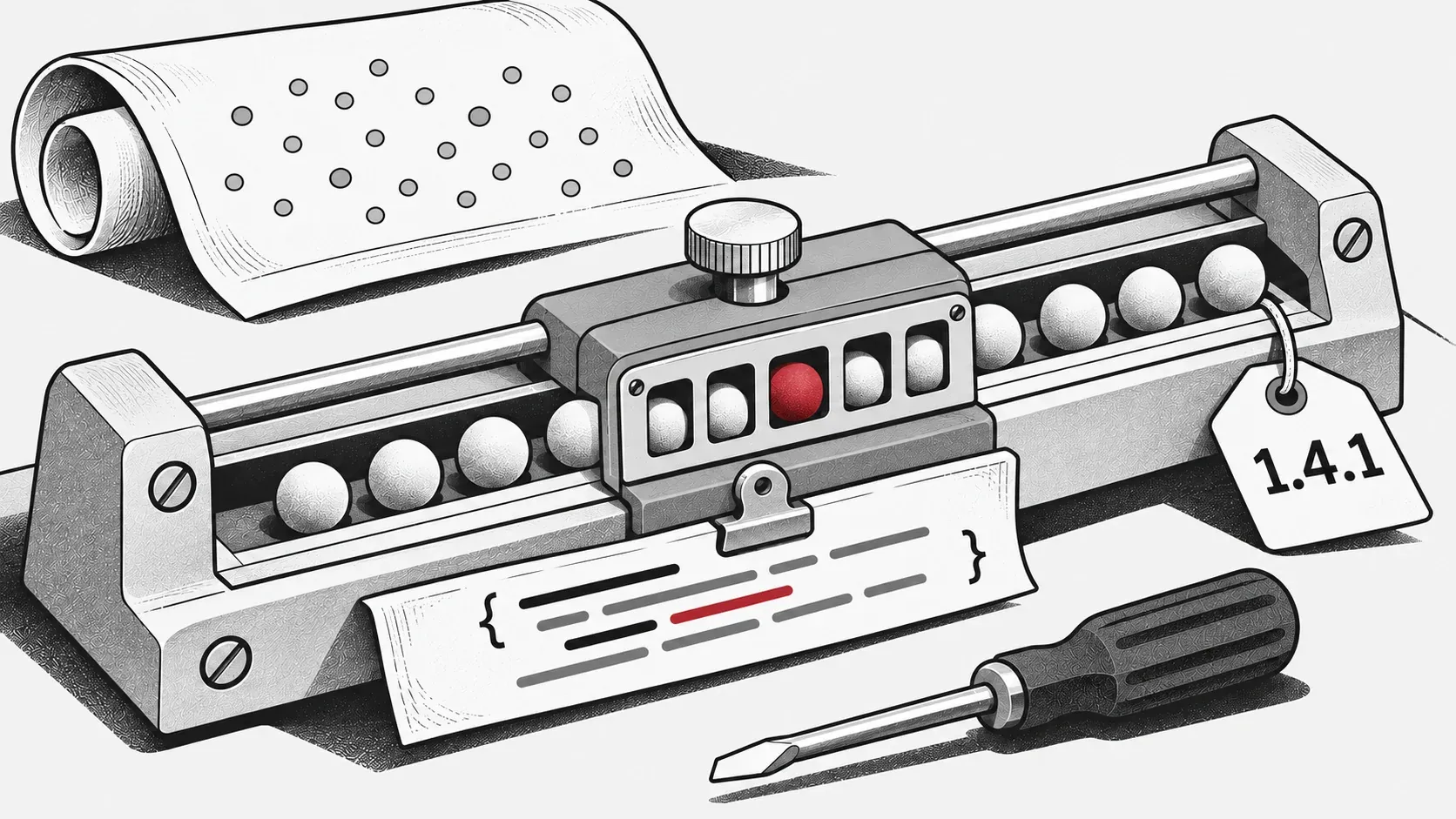
Calibrating implementation against intended algorithm behavior.
When running code searches differently
In SHADE, the success-history memory for F and CR was not adapting. Improvement values were calculated after fitness had already been replaced, and arithmetic with NaN-filled arrays contaminated the selected values. The correction computes improvements before the update and selects successful entries with torch.where. SHADE
The shared binary crossover operator for differential evolution had compared normally distributed random samples with a crossover probability. The correction uses uniform sampling, matching the meaning of that probability. Related fixes also initialize CoDE, SaDE and SHADE populations uniformly within their bounds. These changes affect what candidates are generated, not just whether the program crashes. DE
Numerical definitions and runtime contracts
CMA-ES fixes cover the rank-one covariance update and the cumulation constant, alongside failures caused by aliasing restrictions in torch.cond. The latter correction also re-enables a previously disabled CMA-ES test. Mathematical formulas and execution-framework contracts both need attention: satisfying one does not automatically satisfy the other. CMA-ES
The release also addresses evolution-strategy initialization and subspaces, tournament selection, PSO device transfers and hypervolume handling. v1.4.1
Reliability is part of the infrastructure
The SHADE correction adds a regression test that runs five workflow steps, checks that the adaptation memory changes and verifies that it remains finite. For comparisons across versions, record the seed, objective, population and evaluation budget, then rerun affected baselines. The release notes provide the upgrade reference.